

Bot Defense
Most effective bot attack mitigation tools 2026
What is bot attack mitigation — and why it is more critical than ever
A single scalping-bot swarm drains the inventory of a limited release within seconds. Legitimate buyers leave empty-handed. The operator faces chargebacks and a distorted analytics view.
Cases like this pushed bot attack mitigation from a niche concern to a board-level revenue question in 2026. The most effective bot attack mitigation tools now sit alongside firewalls and identity systems in the security stack. They detect, classify, and block malicious automated traffic before it damages the application layer. They do so without adding friction for real users, permitted crawlers such as Googlebot, or legitimate artificial intelligence (AI) agents.
Which industries are most vulnerable to bot attacks?
Seven sectors absorb most automated abuse in 2026. Attack vectors differ by industry, yet the pattern is consistent: the highest-value transaction attracts the most sophisticated automation.
- Financial services absorb 24% of all bot attacks and 46% of account takeover (ATO) incidents in 2025, driven by credential stuffing.
- E-commerce faces scalping and card testing; carding volume has surged 250% since 2022 according to HUMAN Security's 2026 benchmark report.
- Online gaming platforms bleed value through application programming interface (API) abuse and promotion fraud.
- Travel and ticketing operators lose inventory to scalping.
- Media sites see AI scraping approach 20% of median traffic.
- Government portals draw politically motivated distributed denial of service (DDoS) attacks.
- Digital advertising loses spend to click and impression fraud.
Prime Formation regularly works with the first four categories. See our approach to advanced bot detection and mitigation.
The evolving bot threat landscape
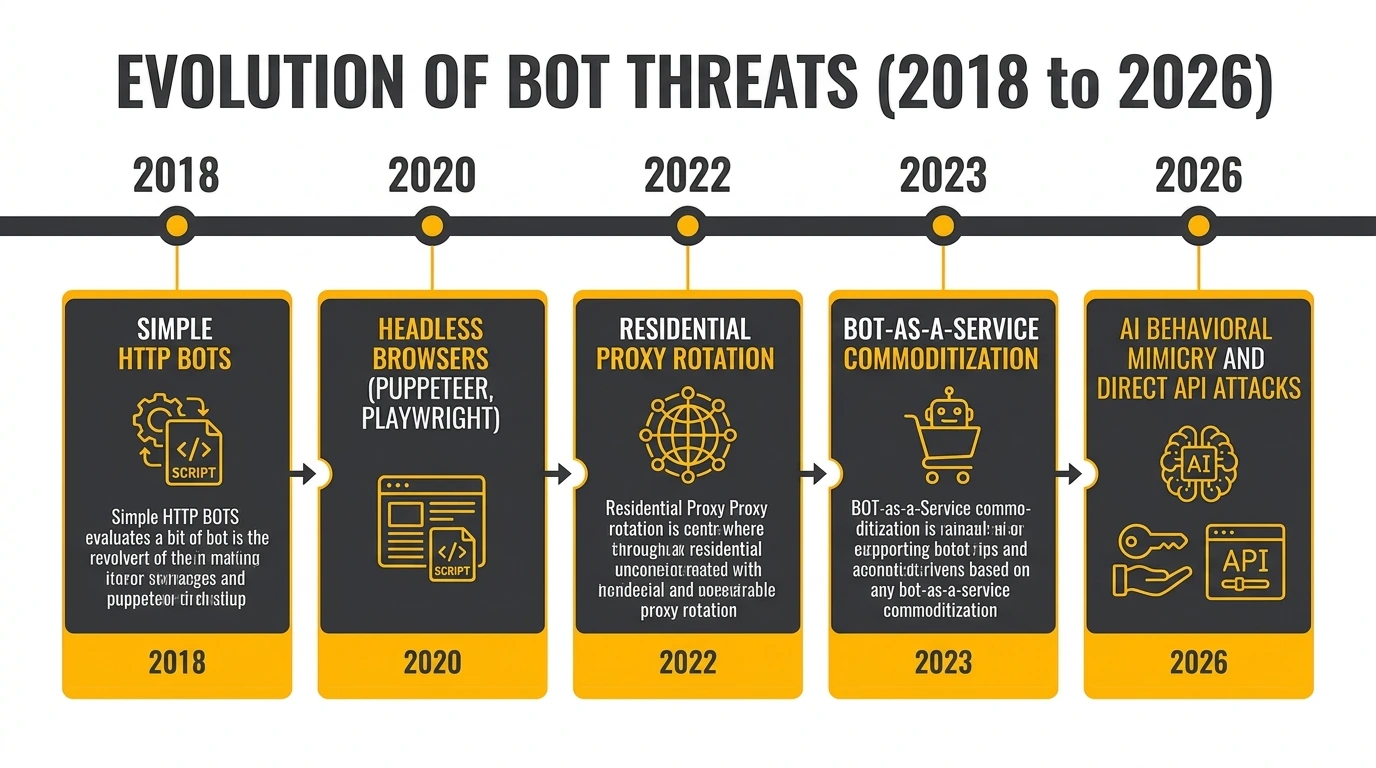
Three structural shifts define the 2026 threat picture. Headless browsers such as Playwright and Puppeteer pass legacy JavaScript (JS) challenges by default, so signature-only detection breaks. Residential proxy pools mask malicious sessions behind internet service provider (ISP)-assigned addresses, defeating internet protocol (IP) reputation lists.
Attackers bypass the user interface entirely and hit APIs at machine speed. 27% of bot attacks in 2025 targeted API endpoints. Bot-as-a-service kits now sell subscription access to advanced techniques, lowering the skill floor.
Carding bots
Carding bots test stolen payment card details through low-value purchases in e-commerce checkout flows, hunting for cards that still authorize. Individual attempts sit well below standard fraud thresholds and blend into normal transaction noise. Detection is difficult because each session looks like an ordinary customer trying one item; only the aggregate pattern across sessions reveals the automation.
Credential stuffing bots
Credential stuffing bots inject username-password pairs leaked from other breaches against login endpoints at scale. From the defender's monitoring, the traffic reads as ordinary failed-login noise rather than an active attack, which is why the technique remains dominant. Multi-factor authentication (MFA) limits damage after a match, yet it does nothing to stop the underlying probing.
Scalping bots
Scalping bots follow a compressed lifecycle. They create disposable accounts, hold inventory the moment a drop opens, complete checkout faster than any human, and flip the stock on a secondary market. Sneaker releases, event tickets, and limited electronics runs remain the recurring targets.
Scraping bots
Scraping bots pull three categories of value: competitor pricing, protected editorial content, and inventory availability signals. The hardest problem is separating malicious scrapers from legitimate crawlers such as Googlebot and permitted AI agents. Anomaly detection against baseline crawl patterns is the mechanism that makes that separation reliable.
Benefits of bot mitigation — why investing in the right tools pays off
Bot mitigation is a revenue instrument, not a security expense. Bots now account for 53% of all global web traffic, with bad bots at 40%, per the 2026 Imperva Bad Bot Report. Five business outcomes justify the spend:
- Fraud reduction cuts chargeback rates and manual review queues.
- Revenue protection keeps inventory and promotional pricing in front of real customers.
- Analytics data quality removes automated noise so conversion numbers reflect actual buyer behavior.
- Infrastructure cost reduction cuts bandwidth, origin central processing unit (CPU) load, and database load.
- Brand trust protection heads off credential leaks and public incidents that damage customer confidence.
The business cost of ignoring bot attacks
Uncontrolled automation translates directly into five categories of financial and operational damage:
- Direct revenue loss from scalping windows, DDoS downtime, and promotion budgets drained by coordinated abuse.
- Account takeover and fraud exposure, with financial services carrying 46% of account takeover incidents in 2025.
- Analytics distortion that misleads product and marketing decisions because dashboards mix bot traffic with real users.
- Infrastructure cost inflation from origin capacity, log storage, and third-party verification services drained by automated requests.
- Brand and regulatory risk, since credential dumps that surface publicly damage customer trust and can trigger General Data Protection Regulation (GDPR) scrutiny.
Types of bot mitigation tools: a categorical map before you evaluate
Most buyers compare vendors before understanding the underlying categories, and the resulting shortlists mix products that solve different problems. Four categories exist in the 2026 market, and a serious deployment usually combines all four rather than choosing one.
- Web application firewalls (WAFs) apply rule-based filtering at the perimeter against known attack signatures. Effective against cataloged threats, yet not built to distinguish bots from humans in real time.
- Challenge-based systems use Completely Automated Public Turing test to tell Computers and Humans Apart (CAPTCHA) puzzles and invisible JavaScript challenges. Cheap to add, expensive in user friction if overused, and increasingly bypassable by commercial solving services.
- Behavioral analysis engines use machine learning (ML) and anomaly detection to score traffic against learned baselines of real human sessions. Modern detection lives in this category.
- Threat intelligence platforms share attacker fingerprints across a client network so a signature detected at one customer becomes an active signal at every customer within minutes.
How bot mitigation tools work: core detection technologies
The best options for real-time bot attack mitigation combine four detection mechanisms rather than relying on any single one. No individual method holds up against modern operators, and marketing materials that suggest otherwise usually hide a layered architecture underneath. The four mechanisms below form the technical foundation of every mature platform.
Behavioral analysis and machine learning
Behavioral analysis carries the primary detection load in every modern platform. The engine ingests session-level signals: keystroke cadence, mouse trajectory, scroll rhythm, click timing, and touch pressure on mobile. It then compares those signals against a baseline of real human sessions on the same site. Dataset width and freshness separate strong vendors from weak ones.
Anomaly detection flags sessions that deviate from the established baseline. It depends on a warm-up period of two to six weeks per site before decisions stabilize. Teams that skip the warm-up and enforce hard-block policies on day one produce a wave of false positives, then blame the tool.
Machine learning models turn those baselines into a decision within milliseconds. Continuous retraining keeps that decision accurate as attacker techniques shift. That combination makes the best options for real-time bot attack mitigation viable at production scale.
Device fingerprinting
Device fingerprinting collects dozens of client attributes. Examples include HyperText Transfer Protocol (HTTP) header order, canvas render output, WebGL graphics parameters, installed font list, audio processing stack, and Transport Layer Security (TLS) handshake characteristics. Those attributes hash into a stable client identifier that survives cookie clearing and IP changes.
Headless browsers carry well-documented fingerprint signatures at the network layer, even when the operator has spoofed higher-level attributes. In 2026, JA4+ TLS fingerprints, maintained by FoxIO, dominate as the edge signal. They replaced older JA3 hashes that lost effectiveness once bot toolkits added JA3 randomization. Fingerprinting alone falls short because operators actively invest in spoofing, so every serious deployment pairs it with behavioral analysis.
Threat intelligence and collective defense
Threat intelligence remains the most under-valued differentiator in vendor selection because scale beats sophistication. When one node in a vendor's client network detects a new attack pattern, every other node receives the intelligence within minutes. Each customer benefits from every other customer's exposure to novel attacks.
HUMAN Security verifies more than 20 trillion digital interactions per week across its network. Radware Bot Manager draws collective intelligence from more than 80,000 protected internet properties. Network scale correlates directly with time-to-detect on zero-day bot techniques, which is where boutique vendors struggle most visibly.
Challenge-response mechanisms
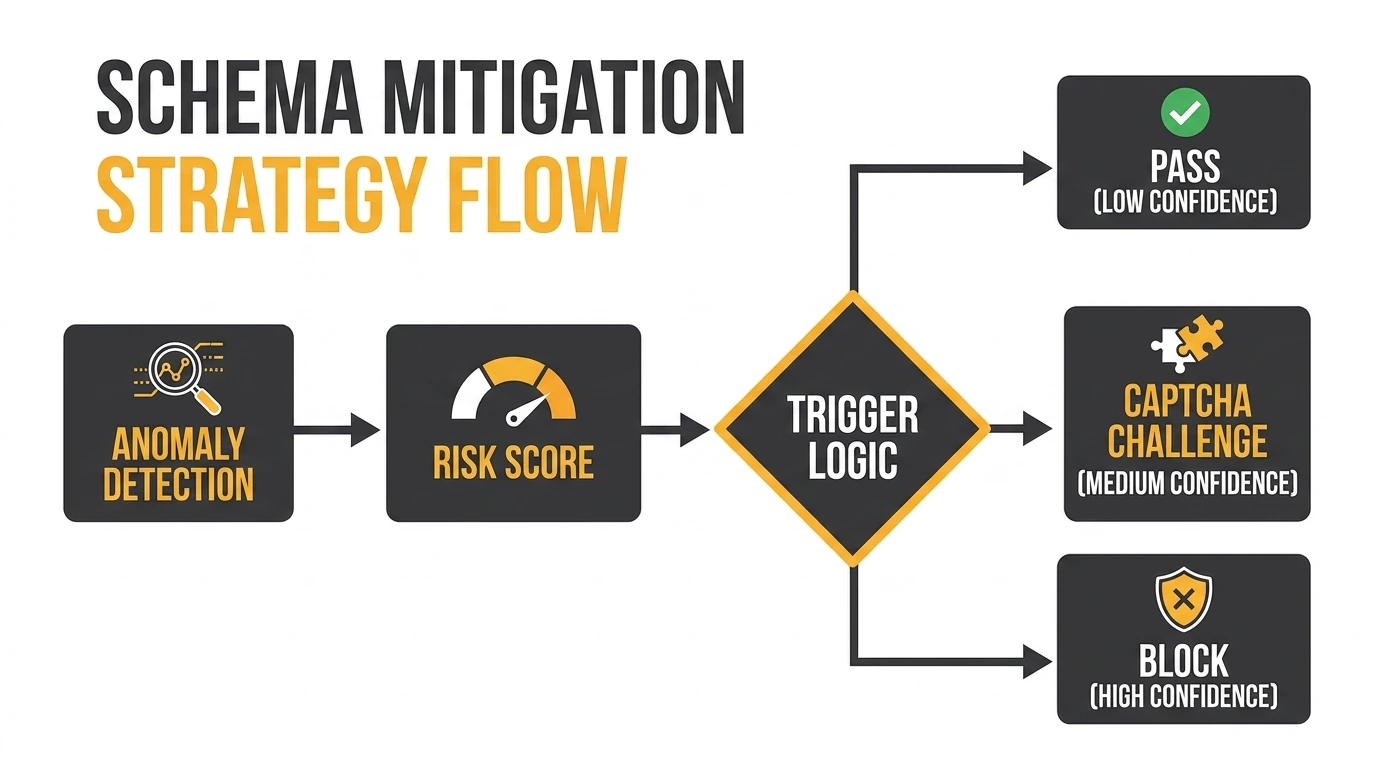
The challenge-response layer changed more than any other since 2020. Traditional CAPTCHAs became a security theater once commercial solving services and AI models started clearing puzzles for cents per solve. Modern challenge-response migrated to invisible JavaScript challenges triggered only on medium-confidence sessions.
Machine learning and anomaly detection produce the risk score. The platform issues a challenge only when that score sits inside a defined gray zone. High-confidence bots receive an outright block. High-confidence humans pass invisibly. Every unnecessary challenge costs conversion, so enforcement policy gates challenges behind explicit risk thresholds that the security team owns.
Enforcement actions — what happens after a bot is detected
Detection and enforcement are two distinct stages that vendor marketing frequently blurs. Detecting a bot is a probability calculation; enforcing against it is a policy decision. Honeypots serve as forensic and disinformation tools. CAPTCHA challenges apply to medium-confidence sessions where an outright block would risk hitting real users. MFA triggers protect account endpoints. Six enforcement modes are standard:
- Block rejects the request outright with a 403 or 429 status.
- Rate-limit throttles the session's request rate without full rejection.
- CAPTCHA challenge deploys an invisible JavaScript check on medium-confidence sessions.
- Honeypot redirect sends detected bots to a decoy environment for forensic capture.
- MFA trigger forces additional authentication on account endpoints when session risk exceeds a threshold.
- Monitor silently logs sessions without enforcing, essential during shadow-mode baselining.
Imperva, HUMAN, and Akamai support all six modes natively.
Key criteria for selecting the most effective bot attack mitigation tool
A systematic evaluation framework cuts through marketing noise. Ease of policy management and analytics quality matter more than they appear at first review. Both determine how the bot mitigation tool behaves in year two.
| What to evaluate | Why it matters in practice |
|---|---|
| Detection accuracy | False positives cost more revenue than blocked bots |
| Bot type coverage | Carding, credential stuffing, scraping, and scalping need distinct signals |
| WAF integration | Native links cut policy fragmentation |
| API and mobile protection | Client-side JS alone leaves APIs and native apps exposed |
| Deployment model | Edge, reverse proxy, or server-side changes latency profile |
| Analytics | Forensic granularity drives tuning quality |
| Scalability | Attacks and promo spikes both demand elastic capacity |
| False positive management | Purpose-built feedback tools save real-customer revenue |
| Threat intelligence network | Larger networks surface novel attacks earlier |
| Compliance | GDPR, Payment Card Industry Data Security Standard (PCI-DSS), data residency drive architecture |
| Vendor support cadence | Detection models drift and need active retraining |
Most effective bot attack mitigation tools 2026: top solutions compared
The seven platforms below appear on almost every enterprise shortlist. The comparison reflects systematic evaluation, client deployments, and continuous market tracking. Any review that highlights only vendor strengths reads as marketing material. Each profile therefore includes a limitation labeled Honestly alongside the differentiator.
| Platform | Primary detection | Target attacks | Deployment | Differentiator |
|---|---|---|---|---|
| HUMAN Security | Collective intel + ML | ATO, ad fraud, scraping | Edge + SDK | Largest signal network |
| Cloudflare Bot Management | ML bot score + JS | Scraping, carding, ATO | CDN + WAF | CDN and WAF integration |
| Akamai Bot Manager | Edge AI + behavioral | Scraping, ATO, DDoS | Global edge | Pre-origin detection |
| Imperva Advanced Bot Protection | ML + anomaly + HD fp | 21 OWASP Automated Threats | Cloud, WAF, on-prem | Native WAF forensics |
| DataDome | AI-native edge | Carding, scalping | 35+ PoPs | Sub-2ms decisions |
| Radware Bot Manager | Intent + deception | Scraping, ATO, API abuse | API + edge | Honeypot forensics |
| Netacea | Server-side sessions | API, mobile, cred stuffing | Server-side | No client JS |
HUMAN Security
HUMAN Security operates the Human Defense Platform on collective intelligence drawn from more than 20 trillion verified digital interactions per week.The Forrester Wave: Bot and Agent Trust Management Software, Q2 2026 placed HUMAN as a Leader with the highest possible scores in nine criteria. Specialized modules address distinct threat categories:
- Account Defender, for account takeover and credential stuffing.
- BotGuard for Applications, for scraping, scalping, and general application abuse.
- MediaGuard, for ad fraud and invalid traffic.
- Malware Defender, for client-side malware and skimming.
Honestly: value scales with traffic volume. Smaller deployments extract less benefit from the collective network effect.
Cloudflare Bot Management
Cloudflare Bot Management assigns each request a bot score between 1 and 99. Scores below 30 typically indicate automation. Detection blends machine learning on request features, JavaScript challenges that surface headless browser signatures, and a verified bot allowlist.
The strongest fit covers organizations that prioritize fast deployment and developer-friendly configuration. Bot management integrates deeply with WAF rules, content delivery network (CDN) caching, and Workers logic. Bot Management ships as an Enterprise add-on and ranks among the most effective bot attack mitigation tools for CDN-native deployments.
Honestly: for API-first architectures, analytics depth on non-web traffic can trail specialized vendors.
Akamai Bot Manager
Akamai Bot Manager sits at the premier enterprise tier. Akamai identifies bots at the global edge network before requests reach origin servers. Detection layers Akamai-validated bot categories, transparent detection against request anomalies, active challenges, and behavioral detection on the Premier tier. Refer to Akamai's detection methods documentation for the technical breakdown.
Two product tiers exist: Bot Manager Standard for general classification, and Bot Manager Premier for transactional endpoints such as login, checkout, and account creation.
Honestly: configuration rewards experienced operators. Less mature teams often find initial tuning complex and benefit from vendor professional services during the first eight weeks of deployment.
Imperva Advanced Bot Protection
Imperva Advanced Bot Protection carries battle-tested credentials and a Leader position in The Forrester Wave: Bot Management, Q2 2022. Detection follows a three-layer architecture. Machine learning scores session features. Anomaly detection flags deviations from learned baselines. High-definition (HD) device fingerprinting persists across attacker attempts to rotate identity.
Coverage spans all 21 Open Worldwide Application Security Project (OWASP) Automated Threats. The platform performs particularly well against credential stuffing by correlating signals across sessions even when the attacker rotates IPs.
Honestly: full functionality demands meaningful investment in deployment and integration. Teams looking for a plug-and-play edge product will find Imperva more capable but more demanding.
DataDome
DataDome runs as a high-speed AI-native platform. The Forrester Wave: Bot and Agent Trust Management Software, Q2 2026 ranked DataDome as a Leader with the highest Current Offering score across all evaluated vendors.
The engine analyzes 5 trillion signals per day across 35+ global edge points of presence, returning enforcement decisions in under 2 milliseconds. Protection covers web, API, and mobile through a single engine, with a stated false positive rate below 0.01%. Fit strengthens sharply in e-commerce and ticketing.
Honestly: complex enterprise architectures with unusual origin topologies should scope carefully during a proof of concept (POC) rather than assume the standard integration path applies.
Radware Bot Manager
Radware Bot Manager, formerly ShieldSquare, differentiates on active deception. Most platforms stop at blocking. Radware adds a forensic layer through honeypots, feed-fake-data responses, and its patented Intent-based Deep Behavior Analysis engine, which ingests more than 250 client parameters.
Intent analysis classifies traffic by what the session is trying to accomplish, not merely whether the session runs on automation. This makes Radware one of the most effective bot attack mitigation tools against sophisticated scraping campaigns.
Honestly: forensic depth generates its full value only when the security team carries analyst capacity to act on the intelligence. Deployments without a dedicated bot analyst underuse the differentiator.
Netacea
Netacea takes an architectural position no other major vendor takes. Primary detection runs server-side against web log data, with zero client-side JavaScript dependency.
The Intent Analytics engine classifies traffic by intent rather than fingerprint characteristics. It asks not is this a bot but what is this entity trying to do. That approach suits API-first and mobile-first platforms poorly served by JavaScript injection. The recent Forrester Wave placed Netacea as a Strong Performer.
Honestly: the model demands thoughtful integration with log pipelines. Teams without disciplined logging or with heterogeneous log formats need architecture planning before rollout.
Side-by-side comparison: bot mitigation tools at a glance
The table synthesizes; it does not rank.
| Platform | Primary detection | Key strength | Ideal use case | Consideration |
|---|---|---|---|---|
| HUMAN Security | Collective intel + ML | Largest signal network | Enterprise, ad-tech | Return on investment (ROI) scales with traffic |
| Cloudflare Bot Management | ML score + JS | CDN-native | Cloudflare estates | Enterprise add-on |
| Akamai Bot Manager | Edge AI | Edge-scale enterprise | Retail, banking, media | Tuning depth needed |
| Imperva Advanced Bot Protection | ML + anomaly + HD fp | OWASP breadth | WAF-integrated | Deployment investment |
| DataDome | AI-native edge | Sub-2ms decisions | E-commerce, ticketing | POC advised |
| Radware Bot Manager | Intent-based | Deception forensics | Analyst-led teams | Analyst follow-through |
| Netacea | Server-side | No client JS | API-first, mobile-first | Log pipeline design |
Implementation realities: what nobody tells you about deploying bot mitigation
Most bot mitigation deployments run at 40 to 60% of their potential effectiveness because tuning stops shortly after go-live. Bot mitigation runs as a security program, not an appliance. Detection models drift as attacker techniques evolve. Policy needs re-tuning after every seasonal traffic shift. APIs remain the coverage gap most teams discover only after an incident.
Prime Formation regularly steps in after an active bot attack has already caused damage because the platform ran on defaults and never got revisited.
Avoiding false positives without sacrificing security
False positives quietly kill any bot mitigation tool program. A blocked legitimate customer complains once, then never returns.
Anomaly detection demands careful tuning against real traffic baselines. Machine learning drives ongoing accuracy improvements. Analytics closes the loop by flagging sessions that scored as bots but still converted. Imperva, HUMAN, and Akamai ship purpose-built tools for surfacing those candidates.
Four techniques cut the false positive rate:
- Shadow mode baselining runs detection in log-only mode for two to four weeks before enforcement.
- Allow-list legitimate crawlers and partners so Googlebot and vetted third parties never trigger challenges.
- Segment enforcement by endpoint criticality so login and checkout carry strict policies while marketing pages carry lenient ones.
- Analytics feedback loop feeds converted low-scoring sessions back into retraining.
Protecting APIs and mobile — not just web
APIs and mobile applications remain the most under-defended surfaces in 2026. Any tool that depends on client-side JavaScript injection delivers close to zero API protection because API clients do not execute JavaScript.
Credential stuffing against a login API works exactly this way: skip the browser entirely, hit the endpoint directly, and rotate through leaked credentials at machine speed. The practical test runs direct: send authentication requests to the API without executing JavaScript, then check whether the platform still scores them. That single test disqualifies several vendors from serious consideration for API-heavy environments.
Adapting to advanced threats — why bot mitigation is never done
The worst bot losses fall on teams that deployed a tool, declared victory, and stopped monitoring. Bot operators reinvest in evasion continuously. Detection accuracy that held up in month one drifts within a quarter unless the platform retrains against fresh attack data. Continuous machine learning retraining separates platforms that stay accurate from platforms that drift. HUMAN, Akamai, and Imperva stay most active on this front. Three practices keep detection sharp:
- Ongoing attack data collection before, during, and after every incident.
- Regular policy review cycles at a minimum quarterly cadence.
- Proactive machine learning model retraining coordinated with the vendor's threat research team.
Conclusion: building a bot-resilient architecture
The most effective bot attack mitigation in 2026 works as an architectural discipline, not a vendor shopping exercise. A working maturity map exists:
- Cloudflare or DataDome for teams starting out and prioritizing time-to-value.
- Imperva or HUMAN for mid-maturity programs that need forensic depth and WAF integration.
- Akamai or HUMAN for global enterprise scale with heavy edge requirements.
- Netacea or Radware for sophisticated threat environments with strong analyst capacity and API-heavy architectures.
API protection stays mandatory in every tier. See our security tuning and enhancement service if ongoing tuning is not resourced internally.
Frequently asked questions
What is the most effective way to stop bot attacks in 2026?
The most effective approach combines four detection layers. Behavioral analysis and machine learning carry the baseline. Device fingerprinting handles client identity. Threat intelligence adds cross-network signals. API-level detection covers the machine-speed surface. No single method holds on its own. The 2026 Imperva Bad Bot Report records 58% of 2025 attacks as advanced or moderate.
How do bot mitigation tools differ from web application firewalls?
A web application firewall filters HTTP traffic against known attack signatures. It never targeted the problem of distinguishing bots from legitimate users in real time. Bot mitigation applies probabilistic detection through behavioral analysis, machine learning, and device fingerprinting to score each session before enforcement. Mature architectures deploy both layers together.
Which industries face the highest risk from bot attacks?
Seven sectors face the highest risk in 2026: financial services (credential stuffing and account takeover), e-commerce (scalping and card testing), online gaming (API abuse), travel and ticketing (inventory scalping), media (scraping), government (DDoS), and digital advertising (click and impression fraud). Financial services absorbed 46% of account takeover incidents in 2025.
Can bot mitigation tools block API attacks, not just web traffic?
Not every bot mitigation tool blocks API attacks. Any platform that relies solely on client-side JavaScript delivers effectively zero API protection, because API clients do not execute JavaScript. Server-side detection platforms such as Netacea and Akamai handle APIs natively. Cloudflare and DataDome ship dedicated API paths alongside their web coverage. Test directly against the API without JavaScript before purchase.
How long does it take to deploy a bot mitigation tool effectively?
Cloudflare and DataDome reach operational web protection within days for standard deployments. Enterprise Akamai and Imperva deployments typically require four to eight weeks before detection stabilizes at target accuracy. That window covers API coverage, custom policy tuning, and shadow-mode baselining before full enforcement.